


Let’s first get it right!
Is Bhagavad Gita for Hindus only? Or for Krishna’s devotees, yogis, or elderly people? Does it advocate war?
No, no, and no!
Then, what is Bhagavad Gita?
Before we tell what Gita is, let us share a famous quote,
Life is 10 percent of what happens to me and 90 percent of how I react to it.
Tweet
And that 90% is Bhagavad Gita. It is all about how one should react to failures and adversities, how to act responsibly, and not defeated by the challenges of life. It throws light on how we should lead a mindful lifestyle by overcoming our desires, making appropriate choices of actions, and managing our emotions.
Gita might sound too mystical or theistic for our taste. But the reality is, Gita is a handbook to a happier life. It is talking about our true self, our life, and our relationship with the universe (or God, if you are a religious person). And so, in short, Gita is all about us, and how we should be in this life. That way, Gita is for all.
What is the backstory of Gita?
Let us imagine being on the Kurukshetra battlefield in ancient India for a moment. The war between cousins Pandavas and Kauravas is about to begin. Armies are organized, the generals are assigned, and Arjuna, the greatest warrior of his time, is ready to defeat his enemies.

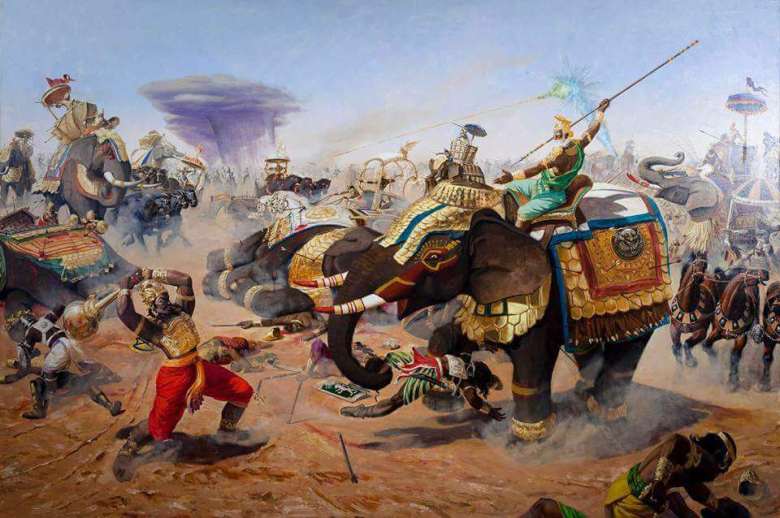
Arjuna, a Pandava prince, is no ordinary warrior. He is the most skilled archer of his time whose archery skill has surpassed everyone else. He has achieved several celestial weapons and won many battles in the past. In fact, the Pandavas are counting on Arjuna to win this war.
Krishna is Arjuna’s charioteer. In ancient times, the chariot, driven by a charioteer, was the supreme military weapon. Masses of chariots were used to get close to the enemies and decimate them with arrows. And that is precisely what Arjuna intends to do.
As the battle draws close, Arjuna suddenly gets the reality check that he must kill his relatives to win this war. He starts lamenting, and he questions the righteousness of the war. He has a panic attack, he drops his weapon, and he tells Krishna, “I cannot fight against my own family. Nothing good could come out of it even if we won this war.”
That is when the Bhagavad Gita starts when Krishna takes charge and explains the necessity of the war to Arjuna.
What is Krishna’s role in this war?
Krishna is not an ordinary charioteer. He has been Pandavas’ advisor for years, he is known for his wisdom, and his knowledge about warfare strategies is brilliant. And he wants Pandavas to win this war; and so he has decided to remain close to the most celebrated warrior Arjuna in the battlefield by being his charioteer (and war advisor).


Now imagine to be in Krishna’s position for a minute. Here everyone is ready for battle. Krishna knows that if Arjuna drops his weapon, Kauravas will win the war. So, his initial thought must have been, “Are you kidding with me? Why do you want to quit NOW? Why did not you think of it earlier?” In fact, he does not hesitate to mock Arjuna in the beginning.
But he realizes that Arjuna is serious about giving up. And at that point, it takes it as his moral responsibility, as a friend, advisor, and war strategist, to convince Arjuna to fight back. Krishna knows if he cannot persuade Arjuna to fight wholeheartedly, then Pandavas are going to lose. And so, whatever it takes to convince Arjuna, he decides to explain why fighting is his duty.
Do I need to read Mahabharata to understand Gita?
Gita appears in the sixth book of Mahabharata, in which its eighteen chapters appear as Chapter 23-40 in the main edition. While it is perfectly okay to study Gita on its own, the understanding of Mahabharata enhances one’s understanding of Gita. We have summarized the story of Mahabharata here.
The central theme in Mahabharata is the nature of dharma or one’s duties. Every character is seeing their responsibilities from their perspective, and they are concerned if they are executing their dharmas within their lives. Every character – male or female – contemplates a lot, and puts his or her views to win the argument. And so, Mahabharata is a debate rather than a unilateral discourse.
The theme of Arjuna debating about his dharma in the Bhagavad Gita aligns with the overall theme of Mahabharata. Perhaps, the author used Arjuna’s character as an illustrative of all humans that are confused, skeptic, conflicted, and seeking answers. He wrote those verses to guide such humans.
Why is Gita so crucial in the Hindu tradition?
Answers might differ. Hinduism has no central scripture. We have thousands of religious texts that are sacred. I think, in modern times, because of the growing interest from the west, we started calling Bhagavad Gita as our main religious text (just as Quran for Muslims and Bible for Christians).
Besides, Bhagavad Gita is a relatively shorter track with just 700 verses. In contrast, the complete edition of Mahabharata has around 100,000. But within those short verses, there is an enormous amount of knowledge that is easy to read and interpret.
When was Bhagavad Gita written?
Like the Vedas and the Upanishads, the authorship of Gita is also unclear. Some scholars suggest it was written at some point between 400 BCE- 200 BCE.
Were these 700 verses added later in Mahabharat? We do not know. What we know is the author of Gita took references from older Vedic texts. But somehow, he knew the limitations of the practical applications of these ancient texts. Thus, he decided to introduce a new concept of Bhakti or devotion at the later chapters of Gita.
The initial chapters are influenced by the Vedic texts, particularly Upanishads. Krishna takes references from these Vedic ideas as he accepts that knowledge itself is the path for liberation.
In the beginning, the teachings of Krishna are very philosophical, intellectual, mystical, withdrawn, and detached. He encourages us to suppress emotions and seek the absolute truth. He emphasizes more on Atman, soul, or self.
Tweet
But somewhere in the sixth chapter, when Krishna is explaining the philosophy of yoga, Arjuna comments, “I cannot be a yogi or an ascetic to seek liberation. Show me an easier path.” This is when Krishna decides to introduce the concept of devotion.
He takes a drastic turn and talks about divine love, emotions, relationships, etc. – ideas that are not mentioned in Upanishads. He no longer speaks about the soul. Instead, he calls himself the Supreme God, who is the absolute controller of the universe. He talks about devotion, praying, and seeking divine grace. It has a religious angle, and that idea is more popular among Hindus today.
Conclusion
Gita is about life. Krishna talks about actions, duties, mental consciousness, wisdom, intention, and human emotions – and they are all relevant to our lives. He promotes the path of knowledge, which fundamentally says we are responsible for our own actions, and we need to focus on finding our inner self.
It is when Arjuna asks Krishna to show him an easier path, he decides to introduce the path of devotion. Here, Krishna is just giving several options for liberation. His teachings are not too rigid. He understands that humans have to live in a society; not all can renounce everything and become a monk; and so we have to learn to find our inner peace in this chaotic world.
He is saying, “Hey, here are all these ways to find your ultimate peace. Here is a ‘path of knowledge’ for you. Do not attach yourself to material possessions. Work hard, but do not expect any outcome. Detach yourself from selfish desires. Find your inner self within you. Be a yogi. Meditate. But if you find this process difficult, I have another path for you. Here, I am God. Devote yourself to me. Surrender yourself and hear my voice. I will never misguide you. Sing, chant, dance, and spread love. At the end of the day, love prevails.”
Either the path of knowledge or devotion (or both), whatever we choose, the teachings of Gita can absolutely change our outlook towards life. Stay tuned as we discuss each chapter with incredible stories in the coming weeks.
Here is a podcast for you
Stay tuned, and do not forget to subscribe if you want to receive our blogs or bi-weekly newsletter (stories influenced by the eastern philosophy) directly in the inbox.
You can join our Facebook Bhagavad Gita Study Group
Do not miss our Podcast titled Gita: A Mantra for Success
Featured Picture Credit: Lars Nissen, Pixabay